How Long Do All-on-4 Implants Last?
How long do All-on-4 implants last? In the longest published studies, about 9 in 10 implants were still in use after 20 years, and very few patients needed a completely new bridge. Most of that evidence comes from one clinic group that lost contact with many patients, so real-world results may be lower. Regular maintenance is essential.
Two Things Can Fail: The Implants and the Bridge
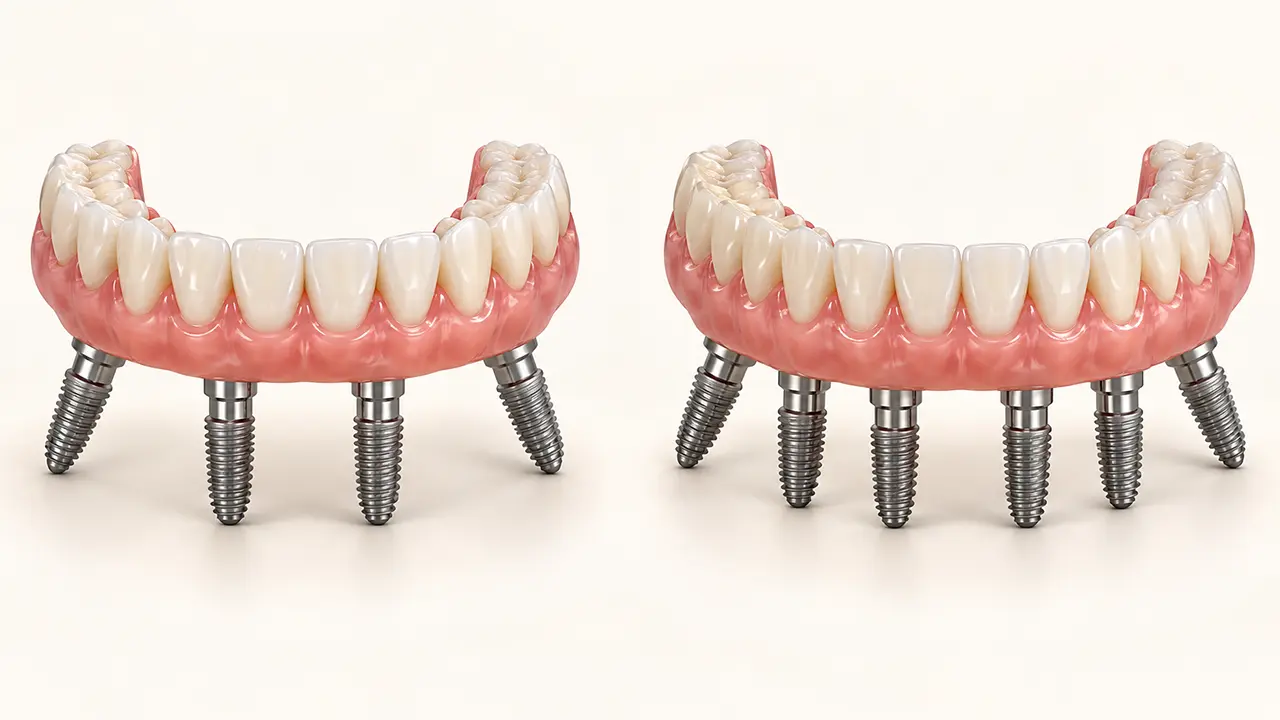
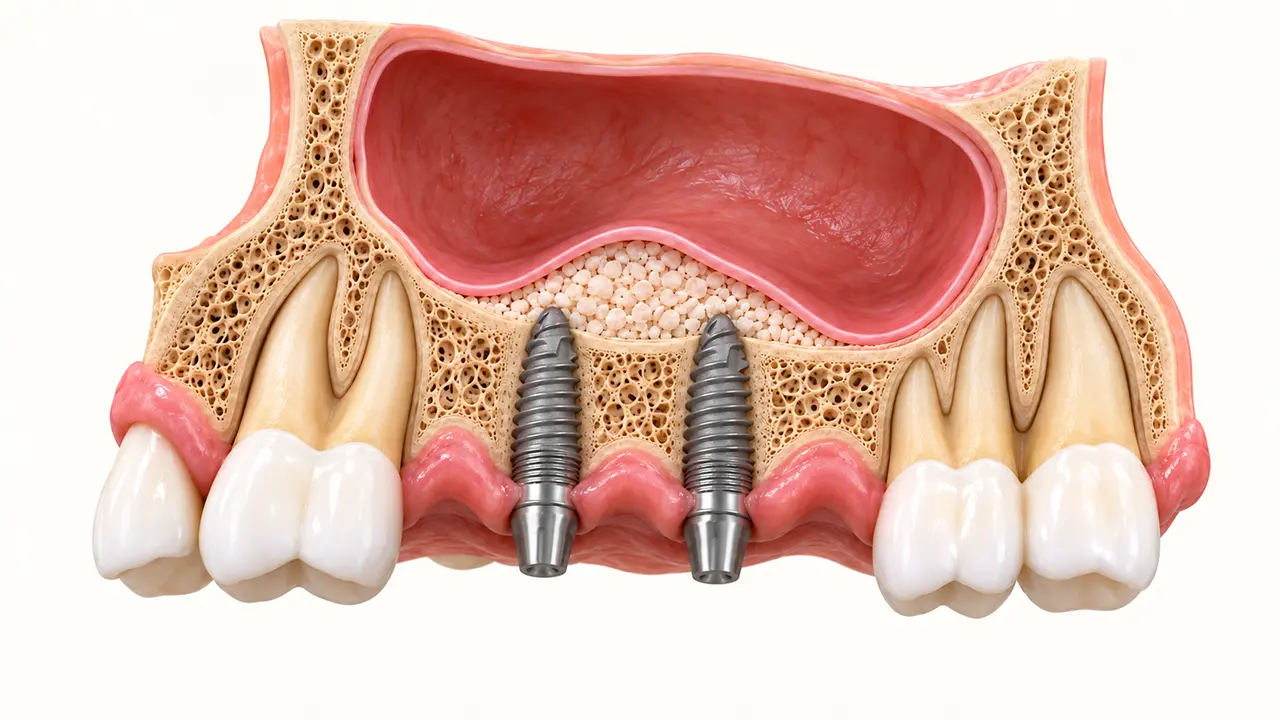
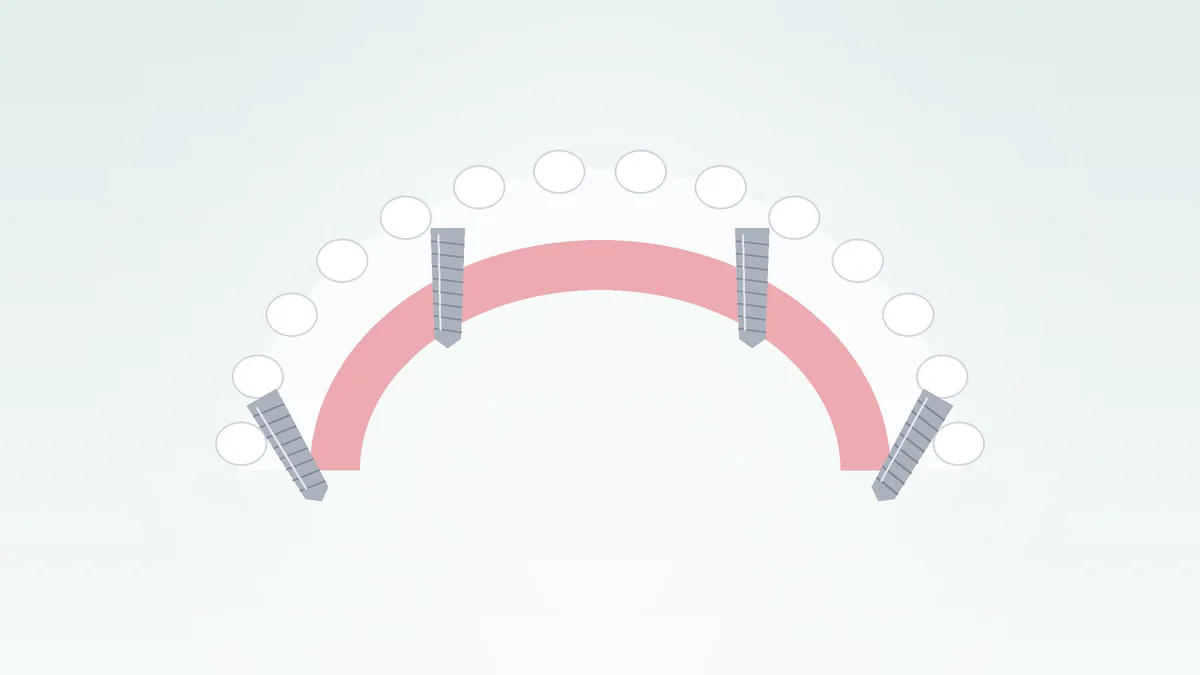
An All-on-4 restoration has two main parts. Four implants, with the back two placed at an angle, are anchored in the jaw. A fixed full-arch bridge, sometimes called a hybrid prosthesis, is screwed onto them. Studies report each part separately:
- Implant survival: the share of individual implants still in the bone.
- Prosthesis survival: the share of bridges still in use without being replaced, even after repairs.
- Success: stricter criteria, such as limited bone loss and no ongoing infection or complications.
One implant can fail while the bridge stays in place, and a bridge can be repaired or remade while all four implants remain healthy. That is why a single "lifespan" figure for All-on-4 is misleading.
How Long Do All-on-4 Implants Last According to Research?
So how long do All-on-4 implants last in practice? Short- and mid-term results are consistently high, and the 10- to 25-year figures are still good, but they need context.
How reliable is the long-term evidence?
Every study in the table with more than 13 years of follow-up comes from the same clinic group, which developed the All-on-4 protocol. All of them are retrospective, and many patients dropped out:
- 20.4% were lost to follow-up in the 13-year upper-jaw study
- 31.6% in the 18-year lower-jaw study
- 38.8% in the 20-year upper-jaw study
- 100 of 181 patients in the 25-year lower-jaw study, where only 3 patients attended the 25-year visit
Missing patients matter. In the 20-year upper-jaw study, the authors calculated that implant survival could be as high as 93.1% if every missing patient kept their implants, or as low as 59.4% if every missing patient lost them. The truth is likely somewhere between. The 25-year study also declared financial ties between several authors and an implant manufacturer.
Common All-on-4 Complications
Mechanical problems are frequent, but most are repairable. Over up to 20 years, 78.5% of patients in the large upper-jaw study had at least one mechanical complication, such as a fractured or loosened component, affecting 60.5% of temporary bridges and 50.5% of final bridges. Biological complications, including peri-implant infections, affected 35.1% of patients and 15.2% of implants.
Shorter studies report much lower rates. A 2026 meta-analysis pooled mechanical complications at 5.91% and biological complications at 6.54%, and its authors cautioned that the included studies varied widely. Definitions and follow-up length explain much of the gap: the longer patients are watched, the more complications accumulate.
Bridge material plays a part. In a review of early studies, fracture of all-acrylic bridges was the major prosthetic complication. The 2026 meta-analysis suggested that zirconia bridges may reduce mechanical complications, but that finding is not definitive.
What Affects All-on-4 Durability?
- Smoking. In the 13-year upper-jaw study, smokers had about twice the risk of implant failure (hazard ratio 1.94), and smoking was linked to infections around implants in several of these studies.
- Previous infection around an implant. A history of biological complications was the strongest predictor of implant loss in the 18-year lower-jaw study (hazard ratio 4.43).
- Grinding. In the 20-year study, 31 patients with implant failures had bruxism, and the clinic made night guards for patients judged to be grinders.
- Sex and jaw. Men had a higher risk of implant failure in the upper jaw and more mechanical complications in the lower jaw. A separate cohort found implant loss linked to jaw type and age.
- Bridge material. The type of restorative material was associated with mechanical complications and, in the 25-year study, with implant failure.
What About All-on-6?
Adding two implants does not clearly extend survival, but evidence is limited. Here is what has been reported:
- A 2026 meta-analysis pooled long-term (5 years or more) implant survival at 98.14% for All-on-4 and 97.50% for All-on-6.
- In a 5-year randomized trial in the upper jaw, survival was 100% with four implants and 99.3% with six; technical complications were 16.6% versus 0%.
- A large 5-year cohort reported 98.4% implant survival for four-implant bridges and 98.7% for six-implant bridges, a difference that was not statistically significant.
No study gives an exact 10-year survival figure for All-on-6. For a full side-by-side look at cost, bone requirements and suitability, see our All-on-4 vs All-on-6 implants comparison.
How to Help Your All-on-4 Last Longer
- Clean under the bridge every day with a water flosser, interdental brushes or superfloss, as your dentist shows you.
- Attend maintenance visits. In the 20-year study, patients were recalled every 6 months after the first year for bridge removal, cleaning and checks.
- Quit smoking.
- Protect the bridge at night with a night guard if you are a grinder.
- Follow the soft-food period after surgery while the temporary bridge is in place.
- Report chips, cracks or looseness promptly.
Signs Your Bridge or Implants Need a Check
- a bridge that rocks, clicks or feels loose
- chipped, cracked or worn teeth on the bridge
- bleeding, swelling or pus around an implant
- pain when biting
- a change in how your teeth meet
- food trapping or bad odor under the bridge that cleaning does not fix
Repair or Replacement Options
- Loose screws can usually be retightened.
- Chipped or worn teeth on the bridge can often be repaired; badly worn acrylic may need a new bridge.
- A fractured bridge is repaired or remade on the existing implants.
- A failed implant may be replaced. In the 20-year study, most patients who lost an implant kept wearing their bridge on the remaining implants during a 6-month healing period, after which new implants were placed.
Because each implant and the bridge can be treated separately, problems rarely mean starting again from scratch. If you are weighing treatment cost against long-term maintenance, our guide to full mouth dental implants cost sets out the numbers.
All-on-4 Treatment at Novexdent
At our Istanbul dental clinic, All-on-4 uses four angled implants to support a fixed full arch, planned from 3D jaw scans. Many patients receive a temporary set of teeth on the day of surgery, followed later by the final bridge. Implants come from Straumann and Medentika. The clinic recommends a night guard for patients who grind, and a patient coordinator follows up after you return home. Our page on dental implants turkey covers the full treatment, and a free online consultation lets the dentists assess your X-rays before you book.
Frequently Asked Questions
How long do All-on-4 implants last if I look after them?
The implants may last decades, but no study can promise a lifetime. In the long-term studies, most bridges stayed in use for up to 20 years, while mechanical repairs were common along the way.
Does the All-on-4 bridge need replacing?
Not always. Very few bridges were replaced over 20 years in the largest study, but chipping, wear and loose parts are common. Temporary acrylic bridges are typically swapped for a final bridge after healing.
What happens if one All-on-4 implant fails?
Often the bridge can stay on the three remaining implants while the site heals, until a replacement implant can be placed. Your dentist decides based on bone and bite forces.
Do All-on-4 implants last longer in the upper or lower jaw?
Results are broadly similar. A 2014 review found no significant difference between the jaws at 3 years, while one large cohort linked implant loss to jaw type. Bone quality and anatomy vary from person to person.
Is a zirconia bridge more durable than acrylic?
Possibly. All-acrylic bridges fractured most often in early studies, and a 2026 review suggested zirconia may reduce mechanical problems. Evidence is not yet strong enough to call one material better for everyone.
References
- Patzelt SB, Bahat O, Reynolds MA, Strub JR. The all-on-four treatment concept: a systematic review. Clin Implant Dent Relat Res. 2014;16(6):836–855. doi:10.1111/cid.12068
- Shao WH, Chen R, Wang S, Duan SY, Zhang XD, Tang YL. All-on-4 and All-on-6 implant-supported fixed prostheses for the edentulous jaw: a systematic review and meta-analysis. Int J Oral Maxillofac Surg. 2026;55(9):1098–1112. doi:10.1016/j.ijom.2026.04.002
- Toia M, Moreira CS, Dias DR, Corrà E, Ravidà A, Cecchinato D. Fixed full-arch maxillary prostheses supported by four versus six implants: 5-year results of a multicenter randomized clinical trial. Clin Oral Implants Res. 2025;36(3):298–313. doi:10.1111/clr.14383
- Caramês JMM, Francisco HCO, Vieira FA, Caramês GB, Martins JNDR, Marques DNDS. Four vs. six implant full-arch restorations: a direct comparative retrospective analysis in a large controlled treatment cohort. J Clin Med. 2025;14(12):4237. doi:10.3390/jcm14124237
- Maló P, de Araújo Nobre M, Lopes A, Ferro A, Nunes M. The All-on-4 concept for full-arch rehabilitation of the edentulous maxillae: a longitudinal study with 5–13 years of follow-up. Clin Implant Dent Relat Res. 2019;21(4):538–549. doi:10.1111/cid.12771
- de Araújo Nobre M, Lopes A, Ferro A, et al. Immediate full-arch maxillary rehabilitation supported by four implants: a retrospective study with 15 to 20 years of follow-up. J Clin Med. 2026;15(2):446. doi:10.3390/jcm15020446
- Maló P, de Araújo Nobre M, Lopes A, Ferro A, Botto J. The All-on-4 treatment concept for the rehabilitation of the completely edentulous mandible: a longitudinal study with 10 to 18 years of follow-up. Clin Implant Dent Relat Res. 2019;21(4):565–577. doi:10.1111/cid.12769
- de Araújo Nobre M, Lopes A, Ferro A, et al. Immediate full-arch mandibular rehabilitation supported by four implants: a retrospective study with 20 to 25 years of follow-up. J Dent. 2026;165:106286. doi:10.1016/j.jdent.2025.106286
LATEST ARTICLES
Beyond the Smile