Zirconia vs Porcelain Crowns: Which Is Better?
In the zirconia vs porcelain crowns debate, neither material wins every case. Zirconia is a very strong, metal-free ceramic. "Porcelain" usually means either porcelain fused to a metal core or a crown made entirely of glass-based porcelain. Over 5 years, zirconia and metal-backed porcelain crowns show similar survival, while all-porcelain crowns made of traditional feldspathic ceramic fare worse.
The better choice depends on which tooth needs the crown, how you bite and how much appearance matters in that spot.
What Counts as a "Porcelain" Crown?
The word covers two quite different restorations:
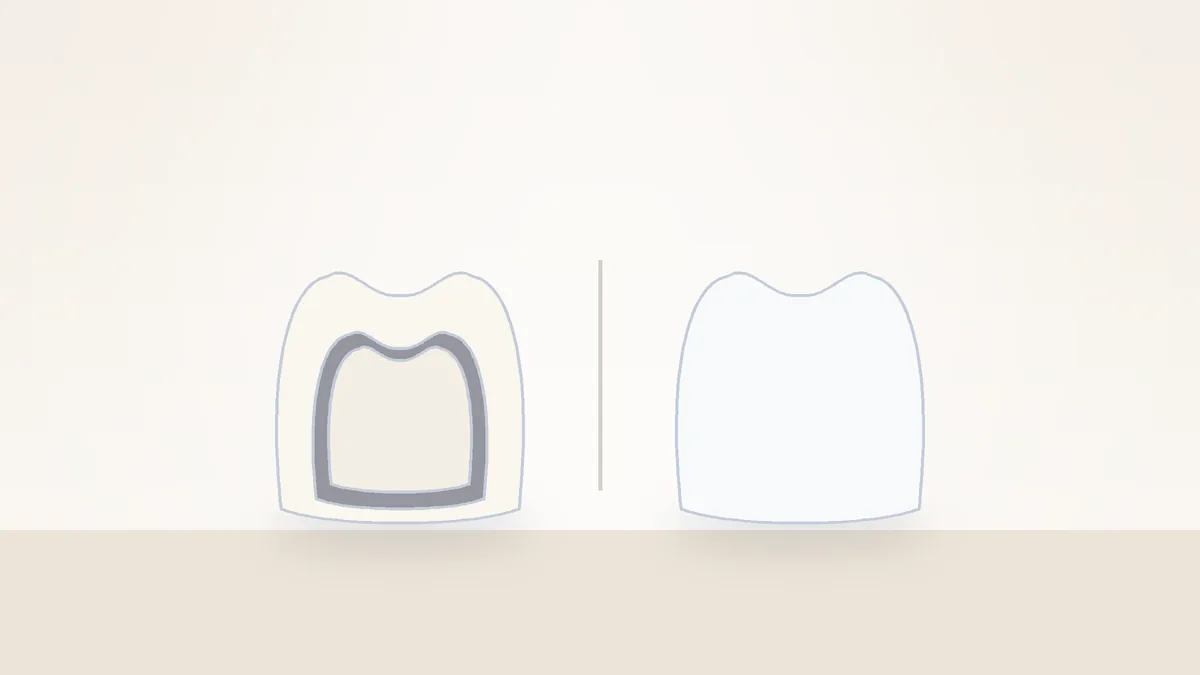
- Porcelain-fused-to-metal (PFM crown). A cast metal framework covered with layers of tooth-colored porcelain. Also called metal-ceramic, it is the material with the longest clinical track record.
- All-ceramic feldspathic or silica-based porcelain. A crown made only of glass-rich porcelain, without a metal or zirconia core. It can look very natural but is mechanically weaker.
Patients and clinics often use "porcelain" for any tooth-colored crown, including zirconia and E.max. The glossary entry on the porcelain crown explains the term. This article compares zirconia with the two meanings above.
How Are the Materials Different?
Zirconia is zirconium dioxide, a dense polycrystalline ceramic. It can be used on its own as a monolithic (solid) crown, or as a core with a layer of porcelain on top. There is no metal anywhere in the crown.
PFM crowns rely on metal for strength. The porcelain layer provides the color but is bonded to a metal frame, so the crown cannot transmit light the way a natural tooth does.
Feldspathic porcelain is mostly glass. That glass content gives it translucency, but also makes it more brittle than zirconia or metal-backed crowns. A 2015 systematic review concluded that these weaker ceramics should be limited to front teeth.
Which Lasts Longer: Zirconia or Porcelain Crowns?
What the systematic reviews show
The two reviews used statistical models to estimate survival at 5 years. They disagree on zirconia. The 2015 review found zirconia crowns were lost more often through veneer fractures and loosening than PFM crowns, and did not recommend zirconia as a first option. The 2026 review, drawing on more recent studies, found zirconia comparable to metal-ceramic crowns, and monolithic zirconia had significantly fewer ceramic fractures and chips than veneered designs. Both reviews rated feldspathic porcelain lowest.
Head-to-head studies
- Randomized trial, back teeth. Monaco and colleagues compared veneered zirconia with PFM crowns on root canal–treated back teeth. After 5 years, estimated survival was 97.7% for zirconia and 97.4% for PFM, with no significant difference. Chipping of the veneering porcelain was the main failure in both groups.
- 15-year molar cohort. Rinke and colleagues followed 91 fully veneered molar crowns. Estimated 15-year survival was 78% for zirconia and 82% for metal-ceramic, a difference that was not statistically significant.
So, on survival alone, zirconia vs porcelain crowns is close to a tie when the porcelain is metal-backed. Evidence beyond 10 years is still much deeper for PFM: one specialist-practice study estimated 85.4% survival at 25 years for high-gold metal-ceramic crowns rated favorably at placement. Our separate guide on how long zirconia crowns last covers the longer-term zirconia data.
How Do They Compare on Appearance?
- PFM: The metal core blocks light, so these crowns can look more opaque than natural teeth. If the gums recede, a thin dark line at the crown edge may become visible.
- Feldspathic porcelain: Often the most lifelike in translucency, which is why it is mainly used for front teeth where forces are lower.
- Layered zirconia: Combines a strong core with a porcelain surface for better aesthetics, though that surface can chip.
- Monolithic zirconia: Tooth-colored throughout with no metal edge, but typically less translucent than layered porcelain.
Advantages and Limitations
Each option in the zirconia vs porcelain crowns choice involves trade-offs.
Zirconia crowns
- No metal, so no gray margin.
- Monolithic versions avoid the porcelain layer that most often chips.
- Similar 5-year survival to PFM in the newest review.
- Long-term data are thinner than for PFM. The 2015 review also reported more technical problems and lower survival on back teeth, a finding the 2026 review did not repeat.
PFM crowns
- Decades of clinical data on survival.
- Widely used on both front and back teeth.
- The metal can show at the gumline, and the porcelain layer can still chip.
- Contains metal, which some patients prefer to avoid.
Feldspathic porcelain crowns
- Excellent translucency for front teeth.
- Lowest 5-year survival estimate of the three, and significantly lower survival in back teeth.
Do They Need Different Care?
Day-to-day care is the same: brush twice daily, clean between the teeth, keep checkups and avoid biting hard objects. The main risk to any crown is decay or gum disease at the edge, not the crown material itself. If you grind, a night guard protects the porcelain layer of PFM and layered zirconia crowns. For general longevity factors, see how long dental crowns last.
Which Crown Suits Which Situation?
Tooth position usually settles the zirconia vs porcelain crowns question more than any single study result.
- Back teeth with heavy chewing forces: monolithic zirconia or PFM are the usual candidates; feldspathic porcelain is not recommended here.
- Front teeth where looks matter most: layered zirconia, feldspathic porcelain or glass-ceramics such as E.max may be considered.
- Patients who prefer metal-free work: zirconia.
If you are weighing glass-ceramic options, our comparison of E.max vs zirconia crowns covers that choice.
Zirconia vs Porcelain Crowns: Comparison Table
Zirconia Crowns at Novexdent
Novexdent's Istanbul dental team offers metal-free zirconia crowns, hand color-matched to your other teeth, as well as E.max crowns. The clinic notes that E.max is less strong than zirconia and may not suit back teeth, so the material is chosen tooth by tooth. To see how treatment is planned, visit the page on zirconium crowns turkey. A free online consultation, based on your photos and X-rays, comes before any booking.
Frequently Asked Questions
Are zirconia crowns more expensive than porcelain crowns?
Prices vary by country, clinic and crown design, so there is no fixed rule. Ask for a written quote that names the exact material.
Can I replace an old PFM crown with zirconia?
Often, yes, if the tooth underneath is healthy. People commonly do this when a dark margin has become visible. Your dentist will check the tooth and gums first.
Which is better for front teeth, zirconia or porcelain?
Both can work. Layered zirconia and all-ceramic options give good aesthetics; PFM may show a darker edge over time. The final decision depends on the shade, the bite and the neighboring teeth.
Is zirconia the same as porcelain?
No. Both are ceramics, but zirconia is a dense crystalline material, while dental porcelain is glass-based. Some zirconia crowns do have a porcelain outer layer.
Do porcelain crowns chip more than zirconia crowns?
Chipping mainly affects the porcelain layer, whether it sits on metal or on zirconia. Monolithic zirconia, which has no such layer, showed significantly fewer chips in the 2026 review.
References
- Pjetursson BE, Pitta J, Balet A, Bjarnadottir GR, Sailer I, Romandini P. A systematic review and meta-analysis evaluating the survival, failure, and complication rates of metal-ceramic, veneered, and monolithic all-ceramic tooth-supported single crowns—Part 1. Int J Prosthodont. 2026;39(3):308–324. doi:10.11607/ijp.9633
- Sailer I, Makarov NA, Thoma DS, Zwahlen M, Pjetursson BE. All-ceramic or metal-ceramic tooth-supported fixed dental prostheses (FDPs)? A systematic review of the survival and complication rates. Part I: Single crowns (SCs). Dent Mater. 2015;31(6):603–623. doi:10.1016/j.dental.2015.02.011
- Monaco C, Llukacej A, Baldissara P, Arena A, Scotti R. Zirconia-based versus metal-based single crowns veneered with overpressing ceramic for restoration of posterior endodontically treated teeth: 5-year results of a randomized controlled clinical study. J Dent. 2017;65:56–63. doi:10.1016/j.jdent.2017.07.004
- Rinke S, Taetzner L, Bürgers R, Leha A, Roediger M. Clinical evaluation of metal-ceramic and zirconia molar crowns: 15-year results from a practice-based cohort study. Int J Prosthodont. Published online October 15, 2026. doi:10.11607/ijp.9909
- Walton TR. The up to 25-year survival and clinical performance of 2,340 high gold-based metal-ceramic single crowns. Int J Prosthodont. 2013;26(2):151–160. doi:10.11607/ijp.3136
LATEST ARTICLES
Beyond the Smile