Root Canal Recovery Time: What to Expect
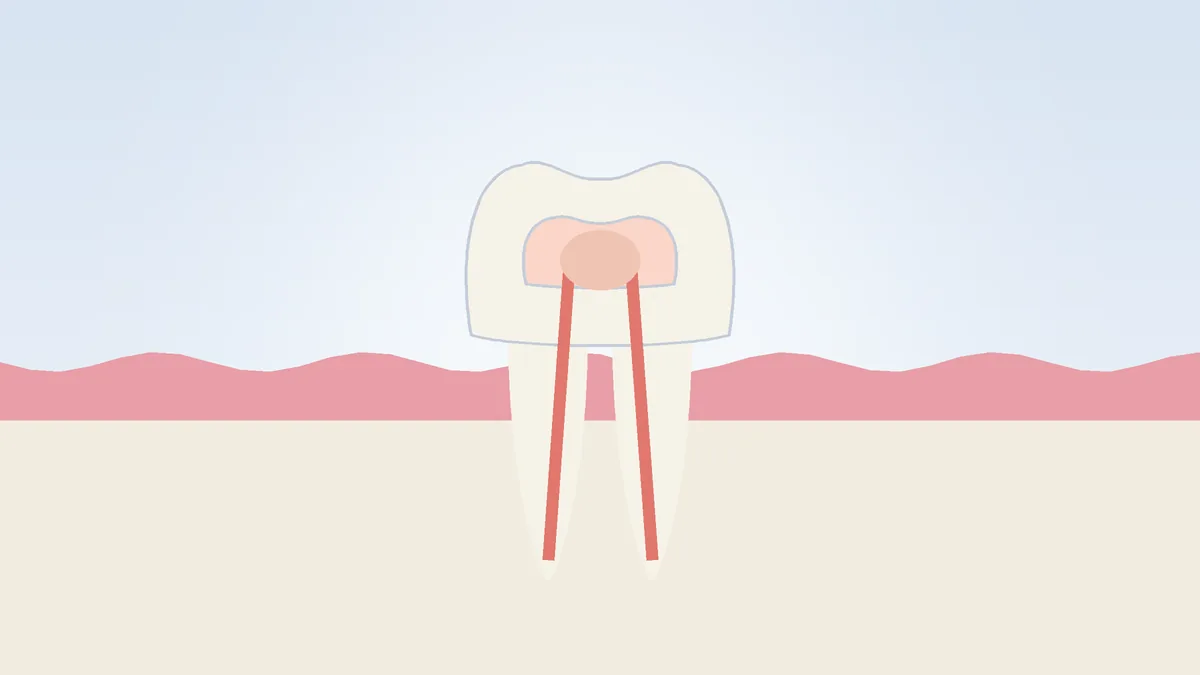
For most people, root canal recovery time is a few days. A review of 72 studies found that about 40% of patients still had some pain 24 hours after treatment, falling to about 11% at one week, with severity dropping to minimal levels. Swelling and soreness should settle within a couple of weeks, while bone around an infected root can take months or longer to heal.
Below, we cover what shapes root canal recovery time, how to look after the tooth and which symptoms need a dentist.
How Long Does It Take to Recover From a Root Canal?
Root canal treatment removes infected or inflamed pulp from inside the tooth, then cleans, shapes and seals the canals. Recovery has two parts: the short period of soreness after the appointment, and the slower healing of any infection in the bone around the root tip.
The short-term part is usually quick. In the 72-study review:
- Before treatment, 81% of patients had pain, with an average severity of 54 on a 100-point scale.
- At 24 hours, pain prevalence had fallen to 40% and severity to 24.
- At one week, only 11% reported pain, and average severity was 5.
In other words, most people feel better than they did before the root canal within a day or two. A minority have a harder first week. In a 2026 study of 1,059 patients from 153 US practices, 14% rated their worst pain in the week after treatment as 7 or higher out of 10. The definitions differ between these studies, so the numbers are not directly comparable, but both show that strong pain at one week is the exception.
Individual healing varies. In these studies, root canal recovery time depended most on the state of the tooth and the pain present before treatment.
Root Canal Recovery Time: A Timeline
The longer stages refer to chronic apical periodontitis, an infection-related lesion at the tip of the root. In the long-term study, 88% of roots with this condition showed signs of healing. You will not feel this process; your dentist checks it on follow-up X-rays.
What Symptoms Are Normal After a Root Canal?
These are common in the first days and usually ease steadily:
- a dull ache or tenderness around the treated tooth
- mild swelling or soreness in the gum nearby
- numbness for several hours after the appointment
- slight discomfort when biting on that side
The key sign of normal recovery is direction: symptoms should get a little better each day, not worse.
What is a flare-up?
A flare-up is severe pain, swelling or both, bad enough to need an unscheduled visit. A 2026 meta-analysis of 15 studies and 24,320 cases found an overall incidence of 2.83%. The strongest risk factors were spontaneous pain before treatment, which raised the risk 5.8-fold, and pain when the tooth was tapped, which raised it 3.5-fold. Dead pulp, an existing lesion at the root tip and re-treatment were also linked to more flare-ups.
How to Look After Your Tooth While It Heals
The NHS advises the following after root canal treatment:
- Take paracetamol (acetaminophen) or ibuprofen if you are in pain, following the dose on the pack or your dentist's advice.
- Be careful not to bump or knock your mouth.
- Go to any follow-up appointments, including the visit to place a permanent filling or crown.
- Keep brushing and cleaning between your teeth to look after the tooth and gums.
- Keep regular dental checkups so the tooth and surrounding bone can be monitored.
If you have a temporary filling, ask your dentist whether to avoid chewing hard food on that side until the final restoration is placed.
Do You Need a Crown After a Root Canal?
Often, especially on a back tooth. Molars and premolars take the most chewing force, and a root-treated tooth has usually lost a large amount of structure to decay and to the access opening. The NHS notes that a crown may be needed if the tooth was badly infected.
The evidence linking crowns to tooth survival is observational but consistent:
- In a study of 203 root-treated teeth, those not crowned after treatment were lost at a 6.0 times greater rate than crowned teeth.
- A systematic review ranked a crown placed after treatment as the strongest of four factors associated with better tooth survival.
- A prospective study of more than 1,600 treated teeth linked a permanent cast restoration, rather than a temporary one, with better survival.
For a back tooth, a full-coverage crown in a strong ceramic is a common way to protect what remains. Our page on zirconium crowns turkey explains how these crowns are made and fitted. To see how long different crowns tend to last, read our guide on how long dental crowns last.
Warning Signs After a Root Canal
Contact a dentist promptly if you notice:
- pain that gets worse after the first two or three days instead of better
- swelling in the gum, face or jaw that grows or spreads
- fever or feeling generally unwell
- pus or a pimple-like bump on the gum, which can signal a periapical abscess
- a temporary filling that falls out or a crown that cracks or loosens
- a bite that feels high, so the treated tooth hits first
- rash, itching or other signs of a reaction to medicine
Severe swelling that affects breathing or swallowing needs emergency care.
Root Canal Treatment at Novexdent
At Novexdent's Istanbul practice, root canal treatment is carried out with rotary endodontic instruments. A typical appointment takes 45 to 60 minutes, and most cases are completed in one visit; complex infected teeth may need two. Before you leave, you receive an Aftercare Kit with medications and hygiene instructions, and a patient coordinator follows up once you are home. If your treated tooth will need a crown, the dentists can plan both steps together after reviewing your X-rays in a free online consultation.
Frequently Asked Questions
Does single-visit root canal treatment hurt more afterward?
The evidence is mixed. A 2022 Cochrane review found that slightly more people reported pain within the first week after single-visit treatment, with moderate certainty. However, it found no difference in pain at 72 hours or one week after the final filling, in flare-ups or in painkiller use. Overall outcomes were similar.
Who is more likely to have severe pain after a root canal?
In a large US study, severe pain in the first week was more common in women, in people with severe pain during treatment, in those who had taken painkillers for the tooth beforehand, and in people with jaw joint disorders or fibromyalgia. Age and tooth type did not predict it.
Does a re-treated tooth recover differently?
Re-treatment is linked to a higher chance of a flare-up, which can make root canal recovery time longer for some people. Over the longer term, though, one prospective study found the same four-year tooth survival of about 95% after both first-time treatment and re-treatment.
How long does a root-canal-treated tooth last?
A systematic review pooled tooth survival of 86% at 2–3 years, 93% at 4–5 years and 87% at 8–10 years after treatment. The studies varied widely, so these are broad estimates rather than a prediction for one tooth.
How long does the appointment itself take?
It depends on the tooth and the clinic. The NHS describes appointments of 1 to 2 hours, often over two or more visits. Many straightforward cases are now finished in a single visit, but an infected or complex tooth may still need more than one.
References
- Pak JG, White SN. Pain prevalence and severity before, during, and after root canal treatment: a systematic review. J Endod. 2011;37(4):429–438. doi:10.1016/j.joen.2010.12.016
- Mungia R, Funkhouser E, Law AS, Nixdorf DR, Diogenes A, Kopycka-Kedzierawski DT, et al. Occurrence and predictors of severe pain one week after root canal treatment: the National Dental PBRN PREDICT endodontic study. J Dent. 2026;164:106232. doi:10.1016/j.jdent.2025.106232
- Ohshima J, Morita M, Kawanishi Y, Abe S, Tanaka N, Shimaoka T, et al. Factors Associated With Endodontic Flare-Ups: A Systematic Review and Meta-Analysis. Int Endod J. 2026;59(9):1778–1791. doi:10.1111/iej.70164
- Ørstavik D. Time-course and risk analyses of the development and healing of chronic apical periodontitis in man. Int Endod J. 1996;29(3):150–155. doi:10.1111/j.1365-2591.1996.tb01361.x
- Aquilino SA, Caplan DJ. Relationship between crown placement and the survival of endodontically treated teeth. J Prosthet Dent. 2002;87(3):256–263. doi:10.1067/mpr.2002.122014
- Ng YL, Mann V, Gulabivala K. Tooth survival following non-surgical root canal treatment: a systematic review of the literature. Int Endod J. 2010;43(3):171–189. doi:10.1111/j.1365-2591.2009.01671.x
- Ng YL, Mann V, Gulabivala K. A prospective study of the factors affecting outcomes of non-surgical root canal treatment: part 2: tooth survival. Int Endod J. 2011;44(7):610–625. doi:10.1111/j.1365-2591.2011.01873.x
- Mergoni G, Ganim M, Lodi G, Figini L, Gagliani M, Manfredi M. Single versus multiple visits for endodontic treatment of permanent teeth. Cochrane Database Syst Rev. 2022;12(12):CD005296. doi:10.1002/14651858.CD005296.pub4
- NHS. Root canal treatment. nhs.uk/tests-and-treatments/root-canal-treatment
LATEST ARTICLES
Beyond the Smile